At a Glance
Platform Prioritization: Focus on Instagram for aspirational visual storytelling, Facebook for community loyalty and event-driven bookings, and TikTok for high-reach "behind-the-scenes" authenticity.
The 60/30/10 Content Rule: Balance your feed with 60% Experience & Local Authority (what it feels like to stay), 30% Social Proof (guest reviews and influencer content), and only 10% Direct Offers to avoid engagement fatigue.
Guest Persona Mapping: Tailor your content to specific booking triggers—Leisure travelers crave visuals and local gems (Instagram/TikTok), while Business travelers prioritize convenience and loyalty perks (LinkedIn/Facebook).
Revenue-First Metrics: Stop chasing likes and start tracking Direct Booking Revenue, OTA Displacement savings, and Cost Per Acquisition (CPA) via GA4 and UTM parameters.
A social media marketing strategy for hotels starts with identifying your ideal guest personas, selecting the right platforms (Instagram, Facebook, TikTok), creating content pillars around experiences rather than rooms, and measuring success through direct bookings - not vanity metrics.
Industry benchmarks from hospitality tech leaders like Cloudbeds and Revinate indicate that structured social media strategies can drive up to 40% higher direct booking rates compared to OTA-heavy models.
Why Do Hotels Need a Social Media Marketing Strategy?
A social media marketing strategy for hotels is the structured plan that aligns your content, platforms, and engagement tactics with revenue goals — turning scrollers into guests. Without one, you're posting randomly and hoping for bookings.
The hospitality industry has shifted. Travelers now discover hotels on Instagram before they ever open a booking engine. According to American Express Global Travel Trend report 2025, over 60% of millennials and Gen Z travelers use social media to research destinations and accommodations before making a reservation. Hotels without a deliberate strategy are invisible to this audience.
Here's what a strategy delivers that random posting doesn't:
- Consistent brand positioning across every platform
- Direct booking increases that reduce OTA commission dependency
- Guest loyalty loops that turn one-time visitors into repeat customers
- Measurable ROI tied to revenue, not just likes
Expert Insight: Most hotels make the mistake of treating social media as a digital brochure. The properties winning on social are the ones creating desire — they sell the experience of staying, not the specifications of a room.
Who Is Your Ideal Hotel Guest on Social Media?
Your ideal hotel guest is a specific persona defined by travel motivation, booking behavior, and platform preference - not just demographics.
Before creating a single post, define 2–3 guest personas that represent your highest-value segments. A boutique hotel targeting couples on anniversary trips operates entirely differently from a business hotel targeting corporate travelers.
Guest Persona Framework for Hotels
| Persona Element | Leisure Traveler | Business Traveler | Event/Group Booker |
|---|---|---|---|
| Primary Platform | Instagram, TikTok | LinkedIn, Facebook | Facebook, Pinterest |
| Content Trigger | Aspirational visuals, local experiences | Convenience, amenities, location | Capacity, packages, testimonials |
| Booking Window | 30–90 days out | 3–14 days out | 60–180 days out |
| Decision Driver | Reviews, influencer content, UGC | Loyalty programs, corporate rates | Event planner referrals, venue tours |
| Key Objection | "Is it worth the price?" | "Is it convenient enough?" | "Can they handle our group?" |
Map each persona to the platforms they actually use. This prevents the common mistake of spreading resources across every channel with mediocre results.

Which Social Media Platforms Work Best for Hotels?
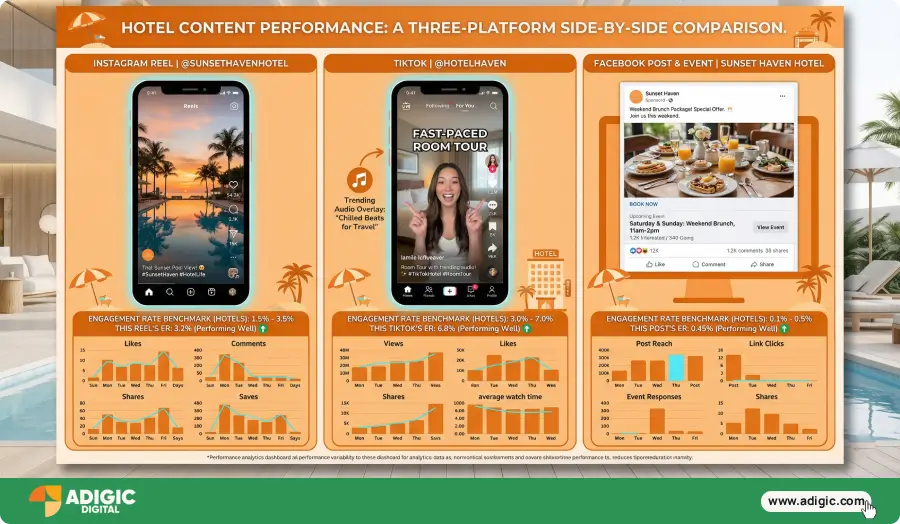
Instagram and Facebook deliver the highest ROI for most hotels, while TikTok is the fastest-growing discovery platform for hospitality brands targeting younger travelers.
Not every platform deserves your budget. Here's where to focus based on what actually drives hotel bookings:
Instagram (Priority 1)
- Why it works: Visual-first platform built for aspirational content — exactly what travel decisions are based on
- Content that converts: Reels of room tours, guest experience stories, behind-the-scenes kitchen content, local area guides
- Key feature: Instagram Stories with "Book Now" link stickers drive direct action
Facebook (Priority 2)
- Why it works: Largest user base in the 35–65 demographic (high-spending travelers), powerful ad targeting, and event promotion tools
- Content that converts: Event promotions, seasonal packages, guest reviews, community engagement posts
- Key feature: Facebook Groups for past guests create loyalty communities
TikTok (Priority 3 - Growing Fast)
- Why it works: Discovery-driven algorithm means even small hotels can go viral with the right content
- Content that converts: Room reveal videos, "day in the life" staff content, local hidden gems, satisfying housekeeping clips
- Key feature: TikTok's algorithm rewards authenticity over production value
Want to grow on tiktok? Here's simple Tiktok growth strategy you can check.
LinkedIn (Niche Use)
- Why it works: Ideal for hotels with conference facilities or corporate travel programs
- Content that converts: Thought leadership from your hotel's GM, corporate event recaps, sustainability initiatives
What Content Should Hotels Post on Social Media?
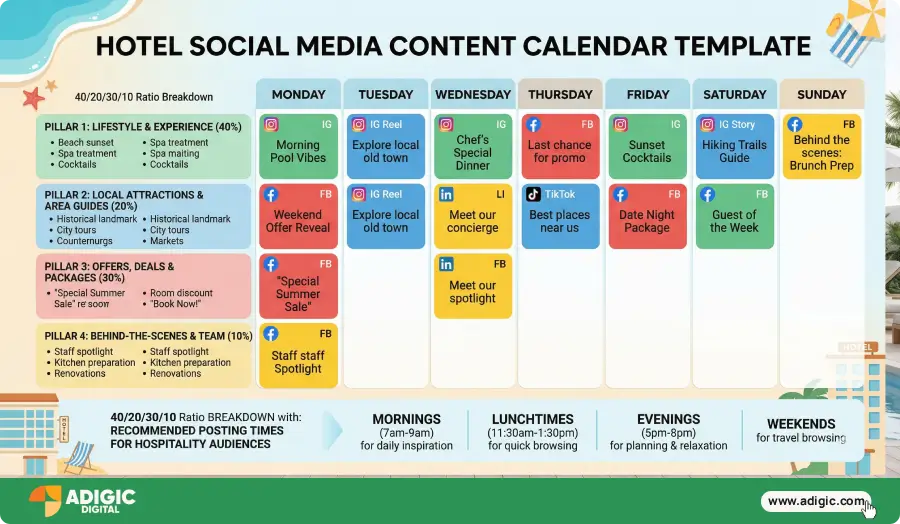
Hotels should post content organized into four pillars: Experience Showcases, Social Proof, Local Authority, and Direct Offers — with a 60/30/10 ratio favoring experience content over promotional posts.
Random content kills engagement. A pillar system ensures every post serves a strategic purpose.
Content Pillar Breakdown
| Pillar | % of Content | Examples | Goal |
|---|---|---|---|
| Experience Showcases | 40% | Room tours, amenity highlights, guest journey stories, seasonal ambiance | Create desire and emotional connection |
| Local Authority | 20% | Restaurant guides, hidden gems, event calendars, area history | Position hotel as the gateway to the destination |
| Social Proof | 30% | Guest reviews, UGC reposts, influencer collaborations, before/after event setups | Build trust and reduce booking hesitation |
| Direct Offers | 10% | Limited-time packages, booking incentives, loyalty rewards, flash sales | Drive immediate revenue action |
Content Formats That Drive Hotel Bookings
- Reels/Short Video (Highest Reach): 15–30 second room reveals, chef plating dishes, sunrise timelapses from balconies
- Carousel Posts (Highest Saves): "Top 5 things to do near [Hotel Name]," packing guides, seasonal itineraries
- Stories (Highest Direct Engagement): Polls ("Pool or spa day?"), Q&A sessions, real-time event coverage
- User-Generated Content (Highest Trust): Reposted guest photos and videos with permission and credit
Expert Insight: The single most underused content type in hotel marketing is staff-created content. A 20-second video of your concierge sharing their favorite local restaurant outperforms polished brand content by 3–5x in engagement. Guests book experiences with people, not buildings.
How Do You Create a Posting Schedule That Drives Bookings?
Post 4–7 times per week on your primary platform, align content with your booking windows, and schedule promotional pushes 30–90 days before peak seasons.
Timing matters more than volume. A hotel posting daily with no seasonal strategy will underperform a hotel posting four times weekly with content aligned to booking cycles.
Recommended Posting Cadence
| Platform | Posts Per Week | Best Times (Hospitality) | Key Scheduling Note |
|---|---|---|---|
| 5–7 (mix of feed + Stories) | 10 AM, 1 PM, 7 PM local time | Ramp up Reels 6–8 weeks before peak season | |
| 3–5 | 9 AM, 12 PM, 3 PM | Event posts need 4–6 week lead time | |
| TikTok | 4–7 | 7 AM, 12 PM, 10 PM | Consistency matters more than timing here |
| 2–3 | Tuesday–Thursday, 8–10 AM | Focus on Q1 and Q3 for corporate travel budgets |
Seasonal content mapping is non-negotiable. Build your calendar around:
- Peak booking windows — Push aspirational content 60–90 days before high season
- Shoulder season — Promote value packages and unique off-peak experiences
- Holidays and events — Create themed content at least 4 weeks in advance
- Local happenings — Piggyback on festivals, conferences, and cultural events in your area
How Do You Measure Social Media ROI for Hotels?
Measure social media ROI for hotels by tracking direct booking attribution, revenue per channel, and cost-per-acquisition — not follower counts or impression numbers.
The metrics that matter connect social activity to the bottom line:
- Direct Booking Revenue from Social: Use UTM parameters on every link to track bookings originating from social platforms
- Cost Per Acquisition (CPA): Total social spend divided by bookings attributed to social channels
- Website Traffic from Social: Track sessions from social referrals in GA4, focusing on booking page visits
- Engagement Rate (Secondary): Useful for content optimization but never the primary KPI
- Share of Voice: How your hotel's social mentions compare to local competitors
Tracking Setup Essentials
- UTM parameters on every bio link, Story link, and ad click
- GA4 conversion events for booking engine visits and completed reservations
- Meta Pixel and TikTok Pixel installed for retargeting and attribution
- Monthly reporting dashboard comparing social CPA to OTA commission costs
Expert Insight: The most compelling ROI argument for hotel social media isn't new bookings - it's OTA displacement. Every direct booking driven by social saves 15–25% in OTA commissions. A hotel generating even 20 additional direct bookings per month from social media saves $3,000–$10,000 monthly in commission fees alone.
How Can Hotels Use Paid Social Media Advertising Effectively?
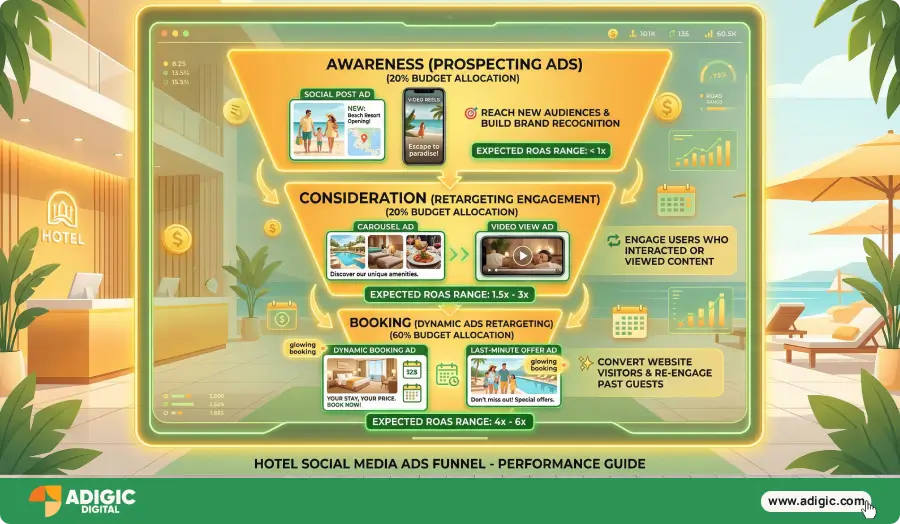
Hotels should allocate 60% of paid social budget to retargeting website visitors who didn't complete a booking, with the remaining 40% split between prospecting and lookalike audiences.
Organic reach alone won't fill rooms. A strategic paid layer amplifies what's already working:
- Retargeting Campaigns: Show dynamic ads featuring the exact room type or package a visitor viewed on your site
- Lookalike Audiences: Build audiences based on past guests who booked directly (upload your CRM list to Meta)
- Seasonal Prospecting: Run awareness campaigns 8–12 weeks before peak periods targeting travelers interested in your destination
- Influencer Amplification: Boost top-performing influencer content as paid ads for 5–10x the organic reach
Budget benchmark: Hotels typically see strong results starting at $1,500–$3,000/month in paid social, with retargeting campaigns delivering 8–12x ROAS when properly configured.
Frequently Asked Questions
How much should a hotel spend on social media marketing?
Hotels should budget $2,000–$8,000/month total for social media marketing, covering content creation, management, and paid advertising. Boutique properties can start at the lower end; larger hotels with multiple revenue centers should invest toward the higher end. The key benchmark: your social media cost-per-booking should be lower than your average OTA commission.
Can small or independent hotels compete with big chains on social media?
Yes — and they often outperform them. Independent hotels have an authenticity advantage that chains cannot replicate. Personal stories from owners, unique property character, and genuine local connections create content that algorithms favor. A 20-room boutique hotel with strong Reels content regularly outperforms a 500-room chain property posting corporate-approved stock imagery.
How often should hotels respond to comments and DMs?
Within 1 hour during business hours and within 4 hours outside business hours. Social media engagement directly correlates with booking intent — a traveler asking about availability in your DMs is a warm lead. Set up notification protocols and assign response ownership to a specific team member per shift.
What is the biggest mistake hotels make on social media?
Posting only about the hotel itself. The most successful hotel social accounts spend 40–50% of their content highlighting the destination, local experiences, and guest stories. Hotels that only post room photos and promotional offers see declining engagement and follower growth within 3–6 months.
Should hotels work with influencers?
Yes, but prioritize micro-influencers (5K–50K followers) in the travel niche over celebrity accounts. Micro-influencers deliver 3–5x higher engagement rates and their audiences trust their recommendations more. Structure deals around content deliverables (specific posts and Reels) rather than just a free stay, and negotiate usage rights so you can repurpose their content in paid ads.

Ready to turn your hotel's social media into a direct booking engine? Book a Strategy Audit with Adigic Digital - we build social media strategies that fill rooms, not just feeds.